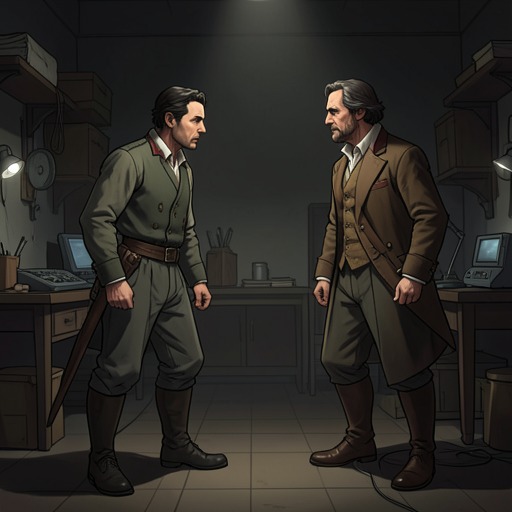
Stand in the enemy's position
The Book of Five RingsTo Become the Enemy is a rule for judging conflict from the opponent’s position rather than from one’s own fears or expectations. Its central example reverses the apparent balance between pursuer and pursued: the person trapped inside a house may seem fortified, but from that person’s perspective the whole world is against them and escape is impossible. The rule turns perspective-taking into a practical means of reassessing advantage, not an appeal to sympathy.
Definition and Reversal
The instruction is to place oneself in the enemy’s position and consider what the situation looks like from there. A robber shut inside a house may be mistaken for a fortified enemy; mentally taking that person’s position instead reveals the confinement as a trap. The text gives the roles a sharper form: the person shut inside is a pheasant, while the person who enters to arrest them is a hawk. The apparent stronghold becomes a cage, and the apparent confrontation is recast as a hunter closing on prey.
This reversal matters because an observer’s first impression can exaggerate the opponent’s power. The rule does not deny that an enemy may be dangerous; it asks the strategist to test that judgment by considering the enemy’s actual predicament. The image of the trapped person makes the method memorable by compressing a change of viewpoint into a change of roles.
Use in Large-Scale Strategy
In large-scale strategy, the text identifies a habitual error: people assume the enemy is strong and become cautious. That caution can arise from the image of the opposing force rather than from a measured appraisal of what it can do. The instruction counters it conditionally. With good soldiers, an understanding of strategic principles, and knowledge of how to defeat the enemy, there is nothing to worry about. Confidence here rests on preparation and judgment, not on pretending the opponent has no strength.
The rule therefore complements the book’s wider attention to initiative and information. Its discussion of forestalling the enemy distinguishes attacking first, acting as the enemy attacks, and meeting an attack with a calm, forceful response. Elsewhere, when the enemy’s position cannot be seen, a strong feint can induce them to reveal their resources, after which a different method may defeat them. These are related ways of resisting a one-sided view: the strategist acts in response to the opponent’s position and conduct, rather than allowing an image of enemy strength to dictate caution.
Use in Single Combat
The same perspective shift applies in a duel. A fighter who thinks the opponent is a master of the Way, fully versed in strategic principles, risks conceding the contest in advance. The text presents this as a mistake of judgment: the opponent’s presumed mastery becomes an intimidating construction that governs the fighter’s own response. Taking the opponent’s position seriously does not mean granting them automatic superiority; it means assessing the encounter without letting an abstract reputation decide its outcome.
The principle belongs to a practice in which physical bearing and perception are trained together. The combat stance is to be maintained in everyday life, and the gaze is trained to see distant things as though close and close things from a distance. The practitioner is also told to notice the enemy’s sword without being distracted by its insignificant movements. Read alongside To Become the Enemy, these instructions establish a discipline of attention: the fighter must neither be captured by appearances nor confuse imagined danger with the opponent’s actual position.
Relation to Action and Significance
Perspective-taking is not detached analysis; it is meant to change action. The book’s close-range methods make that practical emphasis explicit. Glue and Lacquer Emulsion Body instructs the fighter to stick to the enemy with head, body, and legs, closing the gap rather than allowing the body to lag behind. The Body Strike describes entering through an opening in the guard and driving the left shoulder into the enemy’s breast, in time with the breath. Such techniques depend on judging the opponent’s position and the available opening, not simply responding to an intimidating impression.
To Become the Enemy thus links interpretation with initiative. In the house example, a change of viewpoint reveals confinement; in strategy, it checks excessive caution; in single combat, it prevents imagined mastery from deciding the fight before action begins. Its governing distinction is between seeing an opponent as an imposing figure from outside and understanding the constraints that shape the opponent’s choices. That shift makes the enemy’s position part of the strategist’s evidence—and a possible source of advantage.